1. 20th WEPA Annual Meeting and International Workshop in Vientiane, Lao PDR
2. Japan Federation of Johkasou Associations Workshop in September 2024
3. Asia Wastewater Management Partnership (AWaP)
4. Water environment in Lao PDR
5. Reviewing challenges identified in WEPA Outlook 2009, 2012, 2018, and 2021 |
|
| 1. 20th WEPA Annual Meeting |
|
The Department of Natural Resources and Environment Inspection of the Ministry of Natural Resources and Environment,
Lao PDR, the Ministry of the Environment, Japan (MOEJ), and the WEPA Secretariat will organize the 20th WEPA Annual
Meeting and International Workshop on 24 and 25 February, 2025 in Vientiane, Lao PDR, followed by a field visit
on 26 February. These events will be held as face-to-face meetings, but online participation will be arranged at
the same time.
The annual meeting will focus on comprehensive water environment management to reduce pollutant loads from diversified
sources in a watershed. Because river basins have different characteristics, different measures are needed to achieve
the desired results. For this reason, pollution inventory analysis is important for government officials who are
formulating appropriate policies to solve problems. Pollutant loads and sources have been discussed in previous phases
of the WEPA. In order to move forward in the new phase and start discussing issues related to the water environment,
we would like to go back to basics and deepen our understanding of the situation to find solutions.
The international workshop that follows the annual meeting will also focus on the pollution inventory and practical
watershed management. The agenda and further details of the meeting will be announced in due course.
|
|
| 2. Japan Federation of Johkasou Associations Workshop in September 2024 |
|
On 12 September, 2024, a special training session on domestic wastewater management was held by the Kanto Regional
Council of the Japan Federation of Johkasou Associations in Kanagawa Prefecture, Japan. The Japan Federation of Johkasou
Associations is a nationwide organization composed of groups related to the manufacture, installation, maintenance,
cleaning, and inspection of Johkasou from all 47 prefectures, as well as designated Johkasou inspection organizations.
The Federation regularly holds training sessions on domestic wastewater management, and the event that led to the WEPA
Secretariat's participation in this training session was their cooperation during the site visit to observe Johkasou
at last fiscal year’s WEPA Annual Meeting.
This time, lectures were delivered by MOEJ, covering the latest Johkasou administration, including the current situation
regarding the enforcement of the revised Johkasou Act and restoration measures for Johkasou following the 2024
Noto Peninsula earthquake. Additionally, Kanagawa Prefecture gave talks on the implementation and issues surrounding
statutory inspections of Johkasou. The WEPA Secretariat introduced WEPA’s activities, including the Annual Meeting,
Action Programs, and the Outlook, as a means of sharing information on water environment management in Asia.
|
|
|
3. Asia Wastewater management Partnership (AWaP) |
|
The Asia Wastewater Management Partnership (AWaP) is a partnership initiated in 2018 by the Ministry of Land,
Infrastructure, Transport and Tourism (MLIT), in collaboration with MOEJ, to raise awareness on wastewater management,
promote monitoring of wastewater management, as well as to provide support to resolve common challenges in partner
countries. WEPA has been collaborating with AWaP, as both organizations share similar objectives, in terms of water
resource conservation through governance and wastewater management.
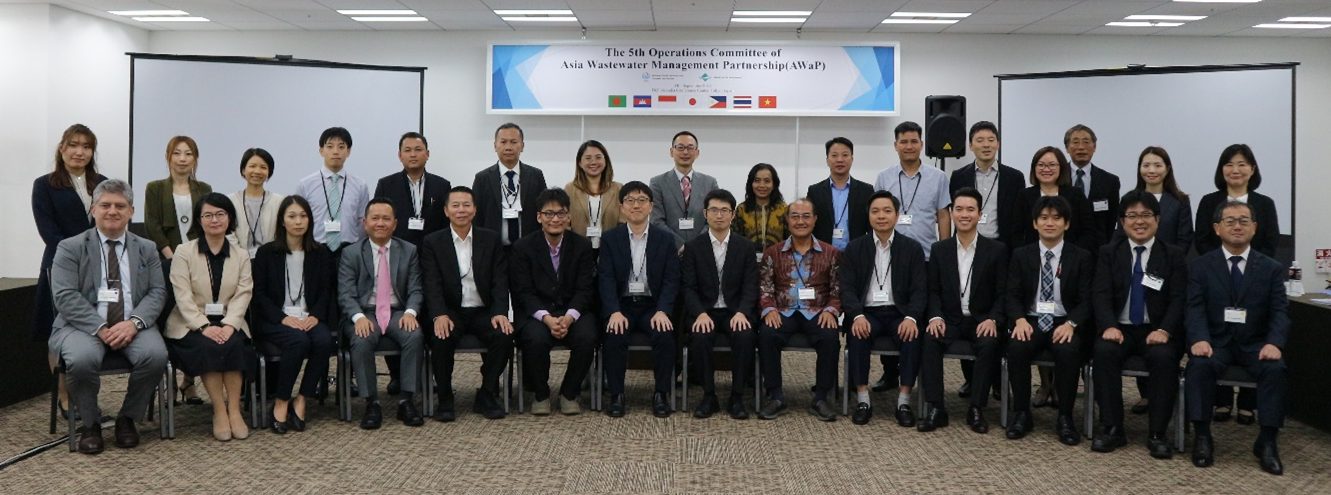
The 5th Operations Committee of AWaP was organized by MLIT and MOEJ and held in Tokyo, Japan, on 24 September 2024,
with representatives from Cambodia, Indonesia, the Philippines, and Viet Nam in attendance. At the beginning of the
meeting, proposals for the admission of two new partners, Bangladesh and Thailand, were approved. The partner
countries discussed four topics in the 2nd work plan. Finding optimal wastewater treatment systems and financing of
sanitation projects were common challenges among partner countries, and difficulties in charging for sewage services
were raised. The majority of AWaP partner countries are also WEPA partner countries, albeit with different ministries
in charge. As such, it is hoped that further collaboration can be developed to accelerate progress towards achieving
SDG 6 in the region.
|
|
|
4. Water Environment in Lao PDR |
|
|
Lao PDR has an area of 236,800 sq.km, about 90% of which is located within the Mekong river basin. Lao PDR is rich in water resources
with about 39 main tributaries flowing into the Mekong river and 62 river basins spread throughout the country. Many small rivers, lakes,
and streams form each year during the rainy season. These water bodies contain high values of total suspended solids as a result of human
activities, including agriculture practices, mining activities, and urban development such as road construction which causes soil erosion.
While the current water quality status is good, these water bodies will face challenges in the future such as water pollution, overexploitation
and impacts from climate change which will negatively impact water quality in coming years.
|
|
Lao PDR has many beautiful waterfalls and rivers that are popular tourist destinations including Kuang Si waterfall in Luang Prabang,
and the Xong river in Vangveing City. It is vital to ensure that sustainable development and tourism practices are carried out to protect
these fragile ecosystems from environmental degradation, as the water environment in these tourist areas faces numerous challenges including
water pollution, habitat degradation, and climate change impacts. To address these issues, the government plans to preserve vital ecosystems
for future generations through the Natural Resources and Environment Sector Vision Towards 2030 “Keeping Lao PDR Green, Clean and Beautiful”.
This strategy is based on green economic growth to achieve sustainable development toward industrialization and modernization and to ensure
resilience from climate change impacts and disaster risks.
The images below show the Xong River in Vangvieng City which supports the daily activities of local residents and provides for tourism activities.
Sengkeo Tasaketh (Department of Natural Resources and Environment Inspection, Ministry of Natural Resources and Environment)
|
|
|
5. Reviewing challenges identified in WEPA Outlook 2009, 2012, 2018, and 2021 |
|
The WEPA Secretariat conducted a survey to gain an understanding of the difficulties faced by government officials when managing the water environment
in 2023. The survey results are presented in the WEPA Fourth Phase Final Report 2024. Responses showed that officials in several partner countries face
similar problems, such as overlapping roles between institutions, enforcement of water pollution-related legislation by multiple ministries, lack of coordination,
and conflicting interests among stakeholders. Lack of resources was also raised by many of the partner countries. This year, the Secretariat is preparing the WEPA
Outlook on Water Environmental Management in Asia 2024, and we plan to analyze how water environmental challenges have changed since the first publication of WEPA Outlook in 2009.
The Secretariat will review the contents of the Outlooks published in 2009, 2012, 2018, and 2021, and analyze the challenges and issues identified by the partners.
The framework of the water environmental governance and policies implemented have three transitional phases of evolvement: (1) assessing the status-quo, (2) establishing
essential policy elements, and (3) gaining a better understanding of progress as well as any problems following the establishment of policy cycles. Therefore, we hypothesize
that government officials face different challenges as they move from an initial stage of addressing water pollution problems (i.e., recognizing water pollution and starting
to monitor) to the middle stage (i.e., starting to develop policies and institutions) and further stages (i.e., assessing results and revising policies). Identifying particular
challenges for a particular stage will enable us to understand what WEPA needs to focus on and how partners can work together.
 According to our preliminary analysis of the data, capacity related challenges are the most frequently mentioned, followed by policy related challenges. Among the capacity related challenges,
human resource issues, such as lack of officials and experts to understand the factors and mechanisms regulating water environment holistically, were most frequently mentioned as a challenge
in water environment management, followed by lack of technological capacity (both in terms of monitoring and tackling the wastewater) in 2009. Lack of public understanding was recognized as a
challenge, and the number of mentions in the texts gradually increased. Thus, the recognition and weighting of challenges has changed over time, and the Secretariat will analyze this and present
the results in Outlook 2024, which will be available on our website in mid-March 2025.
According to our preliminary analysis of the data, capacity related challenges are the most frequently mentioned, followed by policy related challenges. Among the capacity related challenges,
human resource issues, such as lack of officials and experts to understand the factors and mechanisms regulating water environment holistically, were most frequently mentioned as a challenge
in water environment management, followed by lack of technological capacity (both in terms of monitoring and tackling the wastewater) in 2009. Lack of public understanding was recognized as a
challenge, and the number of mentions in the texts gradually increased. Thus, the recognition and weighting of challenges has changed over time, and the Secretariat will analyze this and present
the results in Outlook 2024, which will be available on our website in mid-March 2025.
|
|
|
Call for your contribution to WEPA News! (Please send us any updated information) |
|
|
We are seeking a cooperative agenda with partners. To ensure smooth progress, we welcome information on any new developments on water
environmental governance in your country. If you have any related information, please send it to the WEPA Secretariat by email
< WEPA_secretariat@iges.or.jp >.
|
|
|
|