|





|
||||
|
||||
 |
||||

|
||||
|
Manila Bay is identified as a pollution hostspot
The sustainability of the Bay and its diverse ecosystem is however continually threatened by a variety of land and se-based human activities, which contribute to the decline in its environmental quality. Overexploitation of resources, illegal and destructive fishing, habitat destruction, pollution, siltation and sedimentation, uncontrolled development and the conflicting use of limited available resources cause pressures on the bay. Several laws are being implemented (P.D. 984, DAO 35, R.A. 6969, R.A.2003, P.D. 979) for the protection and conservation of the bay. However, with the increasing complexity of the problem there is a need for multi-agency and cross-sectoral management program. Thus, the implementation of the Manila Bay Environmental Management Project a local component of the Regional Program on building Partnerships in Environmental Management for the Seas of East Asia (PEMSEA). Thus in 2000, the DENR implemented the Manila Bay Environmental Management Project, a local component of the regional program on Building Partnerships in Environmental Management for the Seas of East Asia (PEMSEA). The on-going and proposed initiatives for Manila Bay is entirely based on the Operational Plan for the Manila Bay Coastal Strategy (OPMBCS). This document was a product of inter-agency and stakeholders consultations throughout the watershed which embodies stakeholders vision and action program for restoring the heritage of Manila Bay. It was developed and approved and currently being implemented by the DENR as the lead coordinating agency, and various government agencies to clean the bay. The ruling of the Supreme Court issued in December 18, 2008 compelled various government agencies (DENR, DILG, MWSS, LWUA, DA, PCG, PNP-Maritime Group, PPA, MMDA, DOH, DEPED, DPWH, LGU's and DBM) to implement immediately the OPMBCS under the principle of "Continuing Mandamus" and submit progress report to the Supreme Co The water pollution issue of Manila Bay is on top of the DENR agenda that needs collaborative and immediate actions upon the concerned national government agencies, LGU's, the Civil Society and Business Sector. As the lead agency, the DENR concerns focus on Water Quality Improvement, Habitat Restoration and River Basin Management. Other agencies are committed to implement their plan under the OPMBCS which is also consistent with the respective mandate. Recognizing the important roles and responsibilities of various stakeholders in cleaning the bay the collaboration and coordination among key partners particularly the implementation of Corporate Social Responsibilities (CSR) and mobilize Manila Bay Governance and institutional advancement through the Manila Bay Coordinating Committee (MBCC) with the DENR Secretary as chairman is strengthen.
|


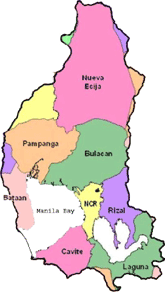 The
Manila Bay is the country’s major hub and international
gateway to its political, economic and social center. It is to
the Filipino people, a natural heritage and a silent witness to
the millennia of Philippine history and the venue of many historical
events that helped shaped the Filipino culture and values. The
Bay, with its semi-enclosed estuary facing the South China Sea,
represents a vital national asset, providing a source of food,
livelihood, employment, recreation, to an estimated 23 million
Filipinos and a major source of economic benefit for the country.
Along with its surrounding provinces, the Bay contributes an estimated
55% of the country’s GDP and account for almost one third
of the country’s agriculture, fisheries and forestry production
and 64 percent of the contribution of industrial and services
sector to the GDP, respectively. It supports fisheries and aquaculture
as among the major sources of livelihood as well as activities
in the following development areas: a) manufacturing industry;
b) shipping and ports; c) agriculture; d) mining and quarrying;
e) commercial areas; and f) residential areas.
The
Manila Bay is the country’s major hub and international
gateway to its political, economic and social center. It is to
the Filipino people, a natural heritage and a silent witness to
the millennia of Philippine history and the venue of many historical
events that helped shaped the Filipino culture and values. The
Bay, with its semi-enclosed estuary facing the South China Sea,
represents a vital national asset, providing a source of food,
livelihood, employment, recreation, to an estimated 23 million
Filipinos and a major source of economic benefit for the country.
Along with its surrounding provinces, the Bay contributes an estimated
55% of the country’s GDP and account for almost one third
of the country’s agriculture, fisheries and forestry production
and 64 percent of the contribution of industrial and services
sector to the GDP, respectively. It supports fisheries and aquaculture
as among the major sources of livelihood as well as activities
in the following development areas: a) manufacturing industry;
b) shipping and ports; c) agriculture; d) mining and quarrying;
e) commercial areas; and f) residential areas.| pagetop |
| POLICIES | TECHNOLOGIES | NGOs & CBOs | SOURCES |
| Home | About WEPA | What's new | Activities | Definitions | Link | Sitemap | Contact Us |
|