|
| Activities by NGOs and CBOs |
Japan |
| Case 2:
Project for Promotion of Rainwater Utilisation |
| Name of Activity |
Project for Promotion
of Rainwater Utilisation |
| Organisation |
(A) People for Rainwater |
| Target Area |
(E) Japan
and Other Asian Countries |
| Activity Period |
1995- |
| Structure
and Budget of Lead Organisation |
Membership: 200
Annual Membership Fees: Regular Member 3,000 yen, Student Member 2,000 yen, Supporting Member 30,000 yen, Commonwealth Member 10,000 yen
Total Budget: 12,000,000
yen |
| Target
Fields |
(B) Water
Resources, Water Environment Conservation
(Water Environment, Water Resources,
Disaster Prevention) |
|
Project Background and Objectives
A project for rainwater utilisation started in 1982. In big
cities such as Tokyo, roads and sites are paved with concrete or asphalt.
Due to it, water circulation in the big cities has been interfered and
rainwater has neither moistened the ground nor been utilised as resources.
In consequence, many of the big cities demanded water resources from
dams further above. However, it is irrational to throw rainwater away
and call for water resources to dams further above; people’s realisation
of the inefficiency led to the start of the rainwater utilization project
to collect water and have rainwater penetrate into the ground.
Urban effects of a flood can be prevented by keeping rainwater
in rainwater tanks and the rainwater saved can also be used as an alternative
source of water supply in an emergency such as a big earthquake. In
addition, the rainwater can be utilised for tree planting on the roof
and by windows of a building; as a consequence, this can alleviate heat
pollution in cities.
Activities by People for Rainwater aim at cities’ independence
of outside water sources and the revival of natural water
circulation and urban environment in cities on the initiative of citizens.
Project Abstract and Effects of Project
The followings are the main fields of activities by People
for Rainwater:
- Research in Culture and Livelihoods Related
to Rainwater
To get rain back to our everyday life, cultural research on
rain and livelihoods has been conducted. One of the outcomes
is the completion of a rain encyclopaedia called Sky Water, which is
about rainwater utilisation.
- International Cooperation and Support through
Rainwater
People for Rainwater has given international cooperation and
support through rainwater. For example, the Sky Water
Project has started in cooperation with NPOs in Bangladesh to secure
safe drinking water with rain water as underground water in Bangladesh
has been contaminated with arsenic. In March 2002, the English version
of the rain encyclopaedia was published in collaboration with Sumida
Ward, UNEP and IETC.
- The Spread and Enlightenment of Rainwater
Various
projects for the spread and enlightenment of rainwater such as rainwater
fairs and seminars and international conferences and workshops on
rainwater have been undertaken from citizens’ point
of view. A bulletin of People for Rainwater: Amamizu and other
rainwater-related books have also been published. In 2001,
People for Rainwater participated in the establishment of the Reference
Room, where is an information source of rainwater. The Reference Room
has been set up as an annex to the Sumida Environmental Awareness Center
in Sumida Ward, Tokyo.People for Rainwater also took part in the establishment
of the Rain Water House in the same centre in 2005. On top
of that, a database on rainwater is under construction.
 |
| Rainwater Tank |
Distinctive Features of Project (Factors and
Keys toSuccess)
- Rainwater utilisation is gradually taking roots in
society by bringing up an activity to utilise
rainwater stored in local communities and then, letting
the administration and companies know the outcomes.
More than 3,400 buildings utilising rainwater have
been built in Japan so far. In recent years, rainwater
is also getting utilised for residential development.
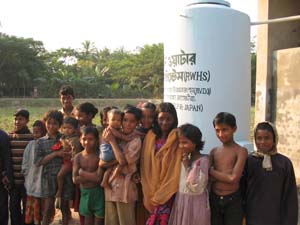 Under the Sky
Water Project, the transfer of the technology
and know-how developed in Japan has contributed to the
breakthrough of the water crisis in the world. For instance,
People for Rainwater has succeeded in developing an inexpensive
concrete tank and bamboo water-intake equipment
with local NPOs in Bangladesh and about 300 of them have
already been equipped there. The project has introduced
the micro credit system as a source of funds, which has
made the project sustainable. Under the Sky
Water Project, the transfer of the technology
and know-how developed in Japan has contributed to the
breakthrough of the water crisis in the world. For instance,
People for Rainwater has succeeded in developing an inexpensive
concrete tank and bamboo water-intake equipment
with local NPOs in Bangladesh and about 300 of them have
already been equipped there. The project has introduced
the micro credit system as a source of funds, which has
made the project sustainable. -
 The national and international spread of human and
information network concerning rainwater has helped
projects utilising rainwater to work more efficiently.
In August 2005, an international conference on the subject
of “Connect the World, and Resolve the Water Crisis
in Asia” was held on the initiative of People
for Rainwater in Tokyo. More than 2,100 people participated
in the conference from all over the world and a practical
issue on how to make water utilisation a part of the
social machinery was discussed. People for Rainwater
is making efforts to spread the ‘rainwater network’ more
and establish the International Rainwater Centre, where
will be a base of its international activities. The national and international spread of human and
information network concerning rainwater has helped
projects utilising rainwater to work more efficiently.
In August 2005, an international conference on the subject
of “Connect the World, and Resolve the Water Crisis
in Asia” was held on the initiative of People
for Rainwater in Tokyo. More than 2,100 people participated
in the conference from all over the world and a practical
issue on how to make water utilisation a part of the
social machinery was discussed. People for Rainwater
is making efforts to spread the ‘rainwater network’ more
and establish the International Rainwater Centre, where
will be a base of its international activities.
Relevant Websites
Reference Information
- Introduction of the Grand Prize of The 4th Japan Water
Prize
- “Let’s Try Water Utilisation”, “Sky
Water”
- People for Rainwater Website
< back
|





