|
| Activities by NGOs and CBOs |
Japan |
| Case 5:
Approach to Water Purification through Activities of the Chemistry Club |
| Name of Activity |
Approach to Water Purification
through Activities of the Chemistry Club |
| Organisation |
(C) The Chemistry
Club, Hiroshima Gakuin High School |
| Target Area |
(E) The Others (Hiroshima
Prefecture) |
| Activity Period |
Studies on Water Purification Started in 1996 |
| Structure
and Budget of Lead Organisation |
Membership: 22
(2 April, 2002)
Advisor: 1 (April,
2002) |
| Target
Fields |
(A) Water Quality Conservation |
|
Project Background and Objectives
The Chemistry Club of the Hiroshima Gakuin High School has traditionally
been doing activities, focusing on the environment. However, nearly
half of the 22 club members belong to both the chemistry club and a
sports club. What is more, activities at culture clubs have been limited
to just once every week; students in the chemistry club have not got
enough time to devote themselves in their studies. Even on days of the
activities during a long holiday, it is difficult for the students to
coordinate days to join a sports club with those to the chemistry club
so that enough time for their studies is unlikely to be secured.
Therefore, in order for the effective use of the limited time, the main
focus of the chemistry club has been on technical development for improvement
in the environment, not on investigation into the actual conditions.
Project Abstract and Effects of Project
- Development of a Treatment Method of Negative
Ion Surface-Active Agents
Domestic waste, which is
inevitably discharged in our daily life, is a main
cause of water pollution and its purification has largely depended
on treatments with microbes. However, anionic surface active agents,
which are widely used and can be found in detergents, shampoo, etc.,
are substances which microbes are poor at deal with. Therefore, an
effective treatment method of anionic surface active agents was developed.
At
first, an electrolytic treatment method was developed. Then, it was
found that powdered silica gel, which has similar constituents as
glass, with positive ion pigment absorbedanionic surface active agents
well when the electrolytic treatment method are used.
This method does not suit for large-scale treatments. However, it
does need no energy such as electricity. Small-scale experiments by
the chemistry club have shown that the method reduced the concentration
of anionic surface active agents to less than 10%.
- Water Purification Concerning the Treatment of Liquid WasteDerived
from Developing Fluid
Studies on the disposal of liquid waste derived from developing fluid
were carried out by the club for fear that the Water Pollution Prevention
Act will prohibit the disposal of liquid waste derived from developing
fluid. The chemistry club focused on titanium dioxide, which is a conclusive
factor for successful purification of the environment, and succeeded
in improving the efficiency of the treatment, resolving its disadvantages
such as difficulty in using radiant energy. The studies were introduced
on newspaper and received a lot of inquiries from companies.
- Water Purification with Chitosan Salt
Chitosan is one of the high polymer biomass and chitin,
which is the main component of shells of crabs and shrimps, ends
up in chitosan if treated chemically. Chitosan had been used as a
cohesive agency to make clouded water clear for long.
Water pollution
result from negative ions in substances which cause water
pollution.
Thereupon, the chemistry club supposes that the capture
of the negative ions by chitosan hydroxychloride acid containing
hydroxy acid can contribute to the solution of the red soil problem,
which has caused serious damage to coral reefs, and the club has
been challenging the problem.
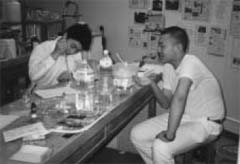
Club Members on Studies Distinctive Features of Project (Factors and Keys to Success)
- The chemistry club has made use of its members’ limited time
available, focusing on technical development
for improvement in the environment.
- The chemistry club of the Hiroshima Gakuin High School has been
actively working; for instance, it has applied for
a patent on the treatment method of anionic surface active agents.
References
- Introduction of the Secretary of the Ministry of Environment Prize
of The 4th Japan Water Prize
< back
|





