|
| Activities by NGOs and CBOs |
Japan |
Case 7:
Approach to a social machinery to make nearby water environment closer and familiar
to People
–Pursuit of ‘Close’ and ‘Familiar’ Water– |
| Name of Activity |
Approach to a social
machinery to make nearby water environment
closer and familiar to People
–Pursuit of ‘Close’ and ‘Familiar’ Water– |
| Organisation |
(A) Water
and Culture Study Group |
| Target Area |
(B) Lakes and Marshes (Waters
of and around Lake Biwa, Shiga Prefecture) |
| Activity Period |
1989- |
| Structure
and Budget of Lead Organisation |
– |
| Target
Fields |
(C) Water Ecosystem Conservation |
|
Project Background and Objectives
Lake Biwa is the biggest lake in Japan, and the lake and the water
system of the River Yodogawa, which pours from Lake Biwa, have supplied
water to big cities such as Kyoto and Osaka.
Due to rapid economic development in the 1970’s, the water environment
of Lake Biwa and the periphery, as well as other areas in Japan, was
rapidly declined in quality. What is more, the movement toward rational
use of the water as a part of general development of Lake Biwa kept
the water away from people’s lives and it became far and invisible
to people’s daily life. At the time, social interest was only
in water pollution, and the relationship between the water and lake
and people was neglected. The majority of policies related to water
were on methods to control drain of pollutants.
From the backgrounds, the Water and Culture Study Group was established,
aiming to make the water closer to people and enrich the quality of
life by focusing not only on water quality and considering the water
environment in everyday life.
Project Abstract and Effects of Project
The group has made efforts to record experiences and memories in daily
life, which are unlikely to be kept in letters. Also, water environment
inquiry led mainly by citizens was planned and practiced to increase
citizens’ sense and power.
- HotaruDAS Examination
The ecology and distribution of creatures in rivers and waterways,
and the change of the relationship between people and fireflies have
been examined. As the result, the activity has increased the number
of people with consideration for waterside and also produced ties between
generations. The HotaruDAS examination has been conducted since 1989
and more than 3,400 people have participated for the past 10 years.
- Draw-up of the Water Environment Chart
Fifty
people conducted fact-findings to 1,000 elderly people in 600 villages
in Shiga prefecture. They examined the water utilisation, the mechanism
of water drainage and rolls of local autonomies as an independent
water management body and 10,000 pages of reports on
them were drawn up. The fact-findings revealed that there was ‘no-waste culture’,
which encourages us to use water and nutrients efficiently, in rural
life in the 1950’s. People at the time naturally had consideration
for stuff.
- Inquiry Into Play at Waterside
Play at waterside in childhood is the one expressing inner
affluence got through contact with water apparently. Inquiry into
play at waterside was conducted, supposing that it can restore the
rich ecosystem which once existed. Then, 6,000 people from three
generations of children, parents and grandparents participated in
the inquiry into play at waterside, and the relationship between
people, creatures and the environment was looked over. The inquiry
revealed that the rich ecosystem once existed was the basics of interest
in play at waterside for children, and fishes caught by children
when they were playing were important as food in their daily life.
What is more, children of today are also seeking for the contact
with creatures; it is important to attract children to waterside
to get back the close relationship between water and river and people.
On
the basis of the results of the inquiry, an activity
called the School of Water as a Bridge Between Generations has started,
seeking for fun in the relationship with water by knowing history
of water and people and then, experiencing old play. In addition,
practical provision against floods has been given by
telling water threat, etc. as it can sometimes be threat.
Distinctive Features of Project (Factors and Keys to Success)
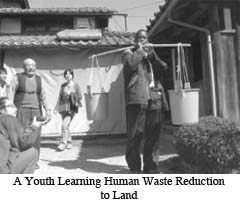 To strengthen ties between the locals and the world, waterside
inquiry has been conducted in China, the USA and Africa since
the late 1990’s. On top of that, people from all over the world
have been invited to communities around. To strengthen ties between the locals and the world, waterside
inquiry has been conducted in China, the USA and Africa since
the late 1990’s. On top of that, people from all over the world
have been invited to communities around.
Lake Biwa by
the Water and Culture Study Group; the group has also
been working internationally.
Relevant Websites
Water and Culture Study Group Website: http://koayu.eri.co.jp/Mizubun/tmenu.htm (Japanese
Only)
References
- Introduction of the Grand Prize of The 7th Japan Water
Prize
- Water and Culture Study Group Website
< back
|





