|
| Activities by NGOs and CBOs |
Japan |
| Case 8:
Project for Restoration of a Reed Belt in Lake Shinjiko –Activities for
water environment restoration by Various Groups– |
| Name of Activity |
Project for Restoration of a Reed Belt in Lake Shinjiko –Activities for
water environment restoration by Various Groups– |
| Organisation |
(A) NPO The Hiikawa Basin Environmental Network |
| Target Area |
(B) Lakes and marshes (Lake
Shinjiko, Shimane Prefecture) |
| Project period |
2002- Present |
| Structure
and Budget of Lead Organisation |
Membership: 239
Annual Membership Fee: Individual
Member 3,000 yen, Group Member 10,000yen per
contribution, Family Member 6,000 yen |
| Target
Fields |
(C) Water Ecosystem Conservation |
|
Project Background and Objectives
Lake Shinjiko is a brackish water lake situated in the downstream
of the Liver Hiigawa water system. It used to be blessed with peculiar
fishes and fish dishes called nanachin or seven delicacies
were very famous. A rich reed belt surrounding Lake Shinjiko has taken
important roles in growing precious regional resources and conserving
the lake’s water quality. However, the coast is covered with concrete
bank protection and the reed belt has been decreasing as human’s
life and economic activities have been prioritised. What is more, inflow
of various liquid waste to the lake and oil discharge accidents have
worsened the lake’s water quality and water environment rapidly.
Thus, to restore the lake’s water environment with the reed belt,
the Citizens’ Group for Reed Restoration in Lake Shinjiko has
been working on the restoration to the reed belt in cooperation with
people in the basin. The group has utilised materials in the basin and
used its original bamboo pots to grow reeds, wooden mattresses for bank
protection formation and mattresses for wave extinguish.
Project Abstract and Effects of Project
The Citizens’ Group for Reed Restoration in Lake Shinjiko is
a cooperative organisation unifying some industries, governments, study
groups and citizens. Children, who shoulder the next generation, are
the centre of its activities.

Organisational Chart
Its activities are;
- Selection of a reed planting site and consultation on
the restoration of the reed bed with the
Ministry of Land, Infrastructure and Transport Government of Japan.
- Enlightenment (lectures, etc.)
- Workshops on wooden pot making for reed planting and
those on water environment conservation.

Workshop of Wooden Pots |
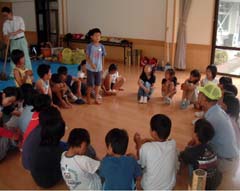
Workshop on Water Environment |
- Events on reed planting.
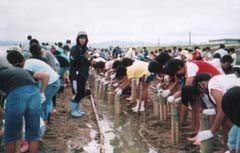
Reed Planting |
- Reinforcement and management after planting. Materials, utilising resources in the River Hii, and construction methods listed below have been used.
- Materials Used: Thick-stemmed bamboos
Purpose to Use: To protect reeds from strong waves in Lake Shinjiko.
Others: Growing bamboos utilised
*A patent obtained by Mr. Kotani, the chairman of the board of directors, in February, 2002.

- Wooden mattresses for River Bank Construction (Used till 2002)
Materials Used: thinnings produced in Shimane prefecture
Purpose to Use: To construct bank protection with reeds.
*A patent obtained by Mr. Kotani, the chairman of the board of directors, in February, 2002.

Before Construction
|
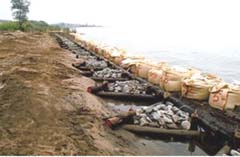
After Construction
|
- Wave extinguish mattresses (brushwood mattresses)
Materials
Used: thinnings produced in Shimane prefecture, brushwood
Purpose
to Use: To protect reed shores from strong waves in Lake Shinjiko.

Before Construction |

After Construction |
- Woven Fences
Materials Used: Thick-stemmed bamboos, thinnings
produced in Shimane prefecture, branches of thinned
cypress
Purpose to Use: To protect reed shores from strong waves
in Lake Shinjiko.

Before Construction |

After Construction |
As a result, 11,576 wooden pots and 23,152 reed saplings have been
planted on the coast of Lake Shinjiko by 2004. In addition, 2,438 elementary
school students, 3,896 if all is counted, have planted reeds. The activities
have been continued so far.

Reed
Belt Restored
Subjective evaluation listed below is also conducted.
- Whether or not a place of “experience of community contribution” has
been provided with students participating the
activities.
- Whether or not a programme with the good combination of study
and social experience, which school aims at, has
been provided.
- Whether or not a place of experience of utilising disorderly
expanding bamboo groves is provided.
- Whether or not effective use of resources to protect
the Liver Hii basin has been successful and whether or not the importance of activities in cooperation of various bodies
has been perceived.
Distinctive Features of Project (Factors and Keys to Success)
The activities are unique in that various organisations and children,
who shoulder the next generation, are working
as the centre. It is also unique that wooden mattresses making bank
protection and bamboo pots for reed planting were developed by the Hiikawa
Basin Environmental Network and they have been utilised for restoration
of the water environment. These characteristics have increased the number
of participants and the organisation’s centripetal force and then,
raised solidarity in the basin.
Relevant Websites
References
- Introduction of the Encouragement Prize of The 7th Japan Water
Prize
- Hiigawa Club Website
< back
|





