State of water environmental issues
4. Water Quality Improvement Measures
(1) Human Health Items
Continuing past efforts to strengthen regulations concerning drainage water from factories and business establishments under the Water Pollution Control Law have resulted in almost all EQSs being achieved, nationwide. However, the water quality monitoring of public water areas needs to be continuously improved and further promotion of water quality preservation measures is needed in order to achieve and maintain all the EQSs.
(2) Living Environment Items
Even though drainage regulations and the improvement of effluent treatment facilities, including sewerage systems, etc., have already been promoted under the Water Pollution Control Law, there is still a need to improve living environment items such as those related to organic pollution (BOD or COD) and water pollution by total nitrogen and total phosphorus, which are also closely related to organic pollution. Therefore, for enclosed water areas (Tokyo Bay, Ise Bay, and the Seto Inland Sea), pollutant load reduction measures (COD, nitrogen, and phosphorus) have been promoted through a “total pollutant load program” based on the Water Pollution Control Law and other related laws. In addition, for 10 Designated Lakes, including Lake Biwa and Lake Kasumigaura, comprehensive water quality preservation measures have been put in place under the “Law Concerning Special Measures for Preservation of Lake Water Quality”.
Designated Lakes
Since lakes and reservoirs are enclosed water areas, they are prone to the accumulation of pollutants, resulting in a lower compliance rate for EQSs than with rivers. The eutrophication of lakes and reservoirs also causes problems with water utilization. There are a wide range of causes for water pollution in lakes and reservoirs and, therefore, it is apparent that the existing regulations under the Water Pollution Control Law, by themselves, are not always well-suited for the conservation of lake water quality. As a result, the Law Concerning Special Measures for the Preservation of Lake Water Quality (hereinafter referred to as the “Clean Lakes Law”) was enacted in 1984 and put into force in March 1985.
Based on the same Law (the Clean Lakes Law), 10 lakes, including Lake Biwa and Lake Kasumigaura, were designated as Designated Lakes. In these designated lakes, useful projects for water quality preservation (such as the improvement of sewerage systems) have been promoted and various other measures (such as the regulation of factory drainage water) have been implemented.
Although these initiatives have gradually reduced the amount of inflow pollutant load in most of the designated lakes, most lakes still do not satisfy the EQSs. Thus, the revised Clean Lakes Law was put into force in April 2006. In addition to existing measures, the Ministry of the Environment decided to introduce and promote new measures to reduce pollutant loads from so-called “non-point sources”, including farmland, urban districts, etc. and to protect the vegetation around lakes in order to help improve lake water quality.
| Designated Lakes (Relevant Prefecture) |
Designated Period |
Lake Water Quality Conservation Plan (FY of the Plan) |
| Lake Kasumigaura (Ibaraki, Tochigi, and Chiba) |
December 1985 |
5th stage (FY 2006-FY2010) |
| Lake Inba (Chiba) |
Ditto |
5th stage (FY 2006-FY2010) |
| Lake Tega (Chiba) |
Ditto |
5th stage (FY 2006-FY2010) |
| Lake Biwa (Shiga, Kyoto) |
Ditto |
5th stage (FY 2006-FY2010) |
| Lake Kojima (Okayama) |
Ditto |
5th stage (FY 2006-FY2010) |
| Lake Suwa (Nagano) |
October 1986 |
5th stage (FY 2007-) planning is underway |
| Kamafusa Dam Reservoir (Miyagi) |
September 1987 |
5th stage (FY 2007-) planning is underway |
| Lake Nakaumi (Tottori and Shimane) |
February 1989 |
4th stage (FY 2004-FY2008) |
| Lake Shinji (Shimane) |
Ditto |
4th stage (FY 2004-FY2008) |
| Lake Nojiri (Nagano) |
October 1994 |
3rd stage (FY 2004-FY2008) |
|
Total Water Pollutant Load Control
In response to the revision of the Water Pollution Control Law in 1978, the Ministry of the Environment institutionalized the “total water pollutant load control program”, targeting three large enclosed sea areas (Designated Water Areas: i.e., Tokyo Bay, Ise Bay, and the Seto Inland Sea) where the population and industrial activities are so concentrated that the existing regulations on drainage concentration, alone, cannot achieve and sustain the EQSs for water quality. The aim of this program is to reduce the total pollutant load in these designated water areas.
Since 1979, an areawide total water pollutant load control program has been implemented to promote pollutant reduction for Chemical Oxygen Demand (COD), up to the sixth stage (*) and for nitrogen and phosphorus, from the fifth stage. Activities in this program include not only total pollutant control for factories and business establishments with an effluent volume of 50 m3 or more per day in the hinterland of each designated water area, but also the improvement of effluent treatment facilities such as sewerage systems and septic tanks and providing instructions on pollutant reduction for nonregulated business establishments.
(※) In the sixth areawide total water pollutant load control program, various measures have been promoted to help achieve quantitative pollutant load reduction targets under the Relevant Prefecture’s Total Pollutant Load Reduction Plan (relevant prefecture notification in June 2007), which has been based on the Basic Policy for Areawide Total Pollution Load Control (established by the Minister of the Environment in November 2006) for which the target completion date is FY 2009. |
Table 1 The Number of Water Quality Monitoring Points in Public Water Areas and the Number of Samples in FY 2006
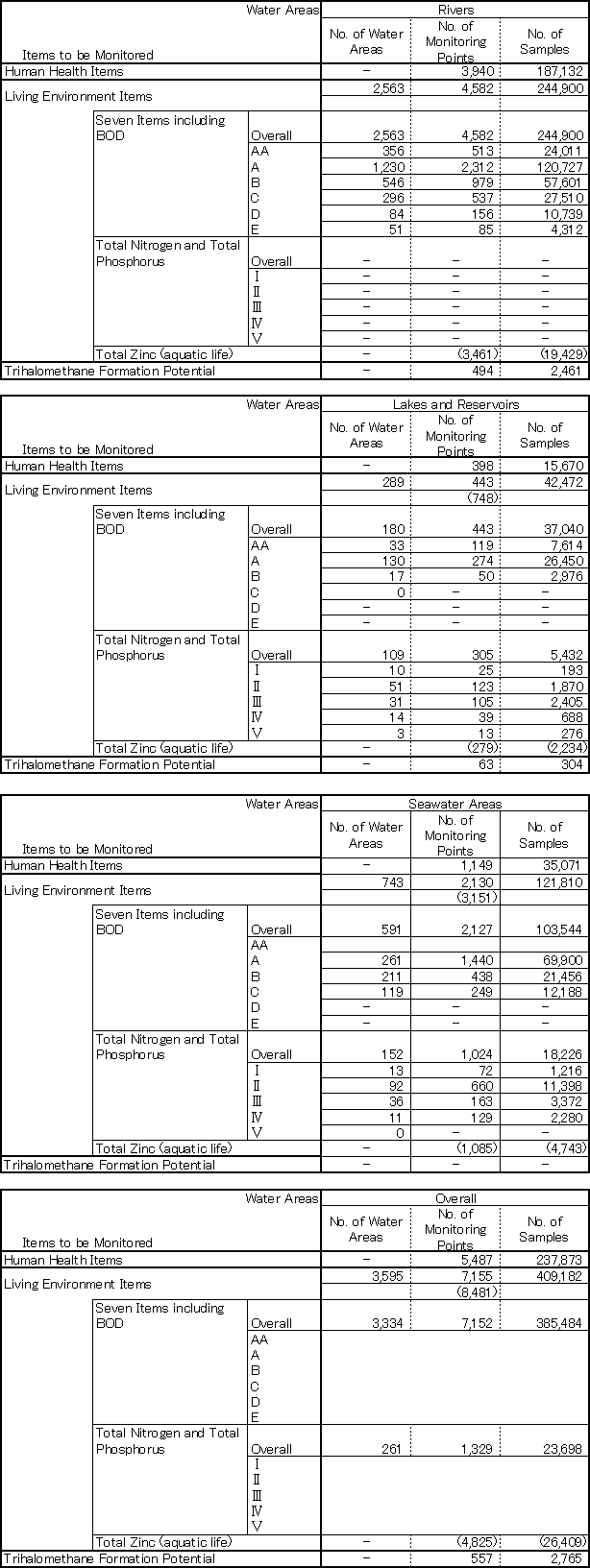
Table 2 Status of Compliance with EQSs for Human Health Items (non-compliance rate)
| [ + Large View ] |
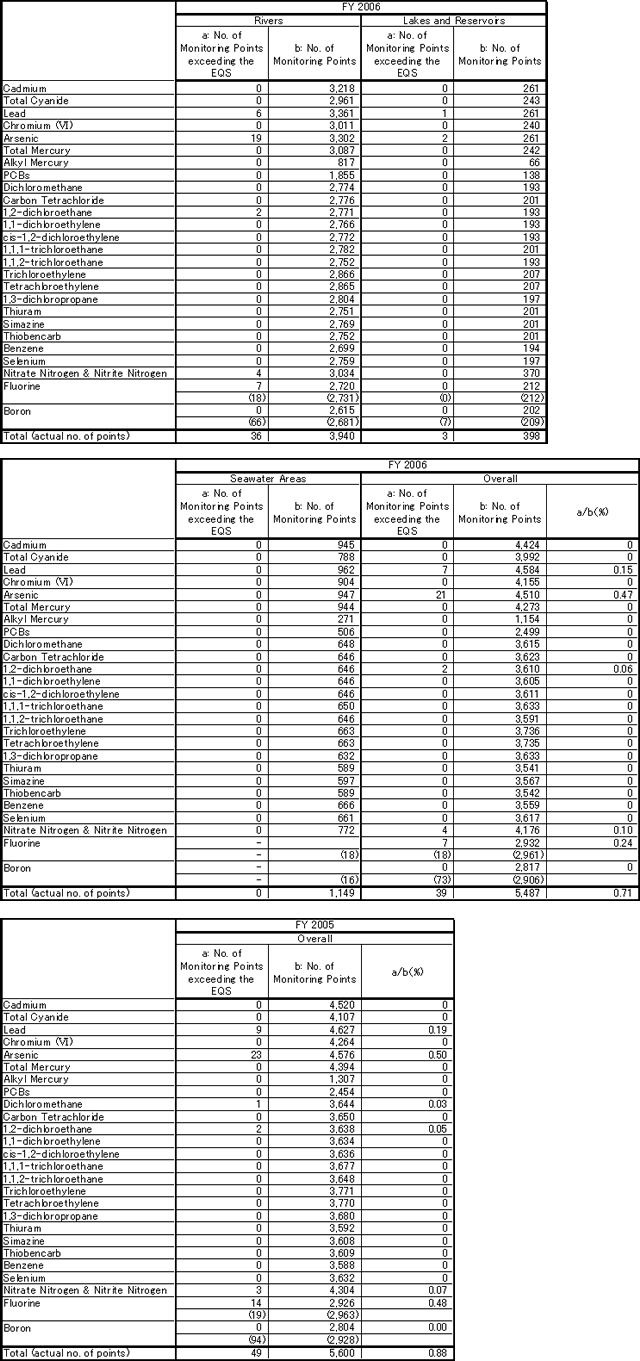 |
| Note: |
1) |
Water quality surveys for nitrate-nitrogen, nitrite nitrogen, fluorine, and boron have been carried out nationwide since FY 1999. |
| |
2) |
EQSs for fluorine and boron are not applied to seawater areas. For reference purposes, the number of monitoring points in seawater areas for these two items is given in parentheses. However, these two items are not included in the category of items to be evaluated nor are they included in the ‘Total’ section.
As in the case of “seawater areas”, the number of monitoring points in rivers and lakes/reservoirs (not including a monitoring point exceeding the EQSs due to the influence of seawater) is shown in the above Table. Figures in parentheses in the lower part of the fields represent the original number of monitoring points, which are included for reference purposes only. |
| |
3) |
The number of monitoring points exceeding the EQSs in the ‘Total’ section shown above is a real number. And also, the number of monitoring point is counted as one point when the monitoring point has a value exceeding EQSs for multiple items. |
|
Table 3-1 Status of Compliance with EQSs (for BOD or COD)

Table 3-2 Status of Compliance with EQSs in Wide Enclosed Seawater Areas (for COD)

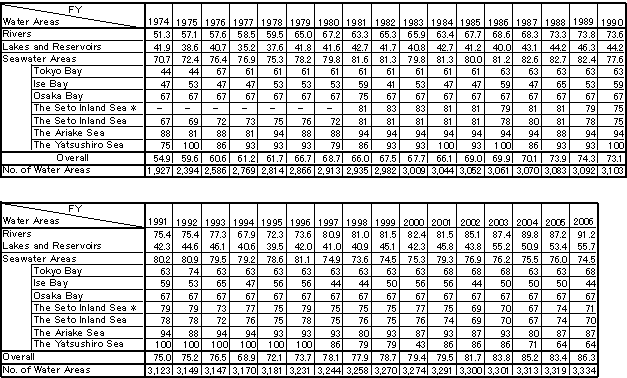
Table 4 Changes in Compliance with EQSs (for BOD or COD)
| [ + Large View ] |
 |
| Note: |
1) |
BOD is applied to rivers while COD is applied to lakes/reservoirs and seawater areas. |
| |
2) |
Compliance rate (%) = (the number of water areas meeting the EQS/the number of specified water bodies by type) X100 |
| |
3) |
Ise Bay includes Mikawa Bay. |
| |
4) |
In the above sections for the Seto Inland Sea, results for Osaka Bay are not included in the upper section but are included in the lower section. |
|
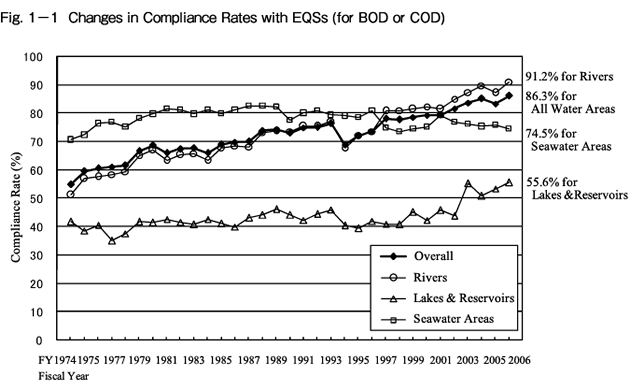
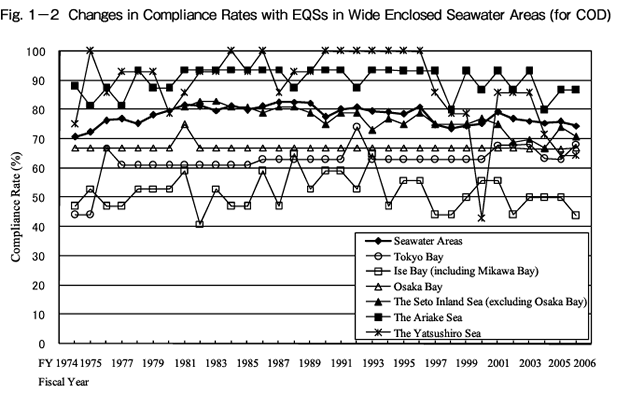
Table 5 Changes in Water Quality by Water Area and by Classification Type (annual averages for BOD or COD)
 |
| Note: |
Data results are calculated using annual average values for BOD and for COD at the environmental standard measuring points of rivers and of lakes/reservoirs and seawaters, respectively. |
|

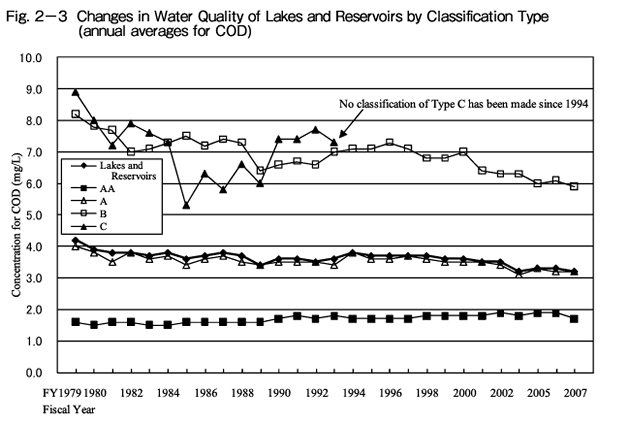

Table 6 Changes in the State of Water Quality in Wide Enclosed Seawater Areas (annual average for COD)

Table 7 Changes in the State of Water Quality in Designated Lakes (COD)
 |
| Note: |
1) |
75% values of COD are shown in the upper part of each section, while annual average values of COD are shown in the lower part of the same section. |
| |
2) |
The highest value out of all the 75% values obtained from each environmental standard point is given as a “75% value”, while the average value of annual averages obtained from each environmental standard point given as an “annual average value”. |
| |
3) |
Overall average values for all designated lakes were calculated by averaging the individual average values obtained from each designated lake. |
| |
4) |
The above number of monitoring points is the FY 2006 number of monitoring points located in environmental standard points for each lake and reservoir. |
|

Table 8-1 Status of Compliance with EQSs for Total Nitrogen (T-N) and Total Phosphorus (T-P) in Lakes and Reservoirs
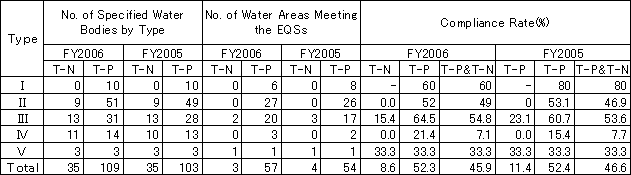 |
| Note: |
1) |
Compliance rates for total nitrogen and total phosphorus are calculated using the following methods: ① For a water area to which EQSs for both total nitrogen and total phosphorus are to be applied, the water area shall be defined as a water area meeting the EQS only if it satisfies the EQSs for both total nitrogen and total phosphorus.
② For a water area to which only EQSs for total phosphorus are to be applied, the water area shall be defined as a water area meeting the EQS only if it satisfies the EQSs for total phosphorus. |
| |
2) |
For lakes and reservoirs, there is no water area to which EQSs for total nitrogen are to be independently applied. |
|
Table 8-2 Changes in Compliance Rates with EQSs for Total Nitrogen (T-N) and Total Phosphorus (T-P) in Lakes and Reservoirs
 |
| Note: |
1) |
As for “total nitrogen”, water areas that satisfy EQSs for total nitrogen were defined as a “water area meeting the EQS”. |
| |
2) |
As for “total phosphorus”, water areas that satisfy EQSs for total phosphorus were defined as a “water area meeting the EQS”. |
| |
3) |
As for compliance with EQSs for “total nitrogen and total phosphorus”
① For a water area to which EQSs for both total nitrogen and total phosphorus are to be applied, the water area shall be defined as a water area meeting the EQS only if it satisfies the EQSs for both total nitrogen and total phosphorus.
② For a water area to which only EQSs for total phosphorus are to be applied, the water area shall be defined as a water area meeting the EQS only if it satisfies the EQSs for total phosphorus. |
| |
4) |
For lakes and reservoirs, there is no water area to which EQSs for total nitrogen are to be independently applied. |
| |
5) |
Water quality surveys for total nitrogen and total phosphorus in lakes and reservoirs have been carried out since 1984. |
|

Table 9 Changes in Concentration of Total Nitrogen (T-N) and Total Phosphorus (T-P) in Lakes and Reservoirs (by classification type)
 |
| Note: |
1) |
Water quality surveys for total nitrogen and total phosphorus in lakes and reservoirs have been carried out since 1984. |
| |
2) |
Data results are calculated using annual average values obtained from each environmental standard point. |
|

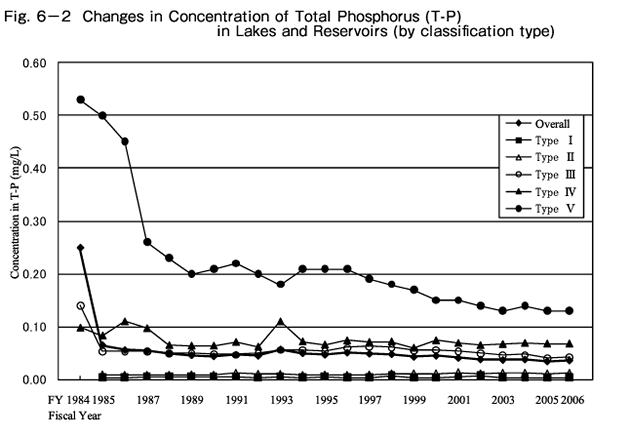
Table 10 Changes in Concentration of Total Nitrogen (T-N) and Total Phosphorus (T-P) in Designated Lakes
| Note: |
1) |
The upper part of each section shows the maximum value of annual averages obtained from each environmental standard point while the lower part of the same section shows the average value of annual averages obtained from each environmental standard point. |
| |
2) |
For the Kamafusa Dam Reservoir and Lake Nojiri (∗), neither of which have been classified by type for total nitrogen, the average value of annual averages obtained from each monitoring point that has been classified by type for total phosphorus is given in the above table. |
| |
3) |
The number of monitoring points shown above is the FY 2006 number of monitoring points located in environmental standard points of each lake and reservoir. |

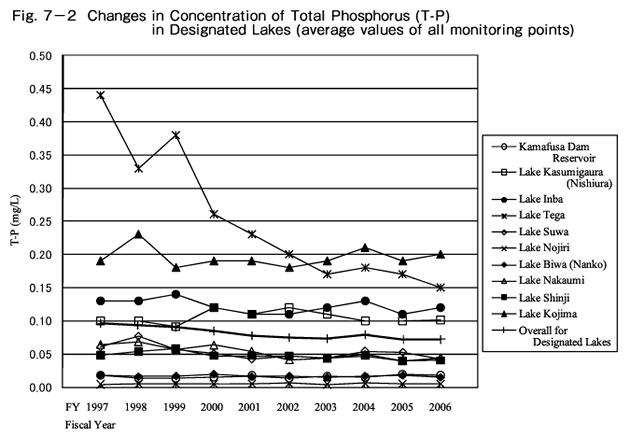
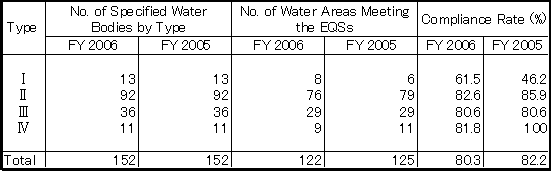
Table 11-1 Status of Compliance with EQSs for Total Nitrogen (T-N) and Total Phosphorus (T-P) in Seawater Areas
 |
| Note: |
1) |
Water areas that satisfy the EQSs for both total nitrogen and total phosphorus were defined as “a water area meeting the EQS”. |
| |
2) |
For seawater areas, there is no water area to which neither EQSs for total nitrogen nor for total phosphorus are to be independently applied. |
|
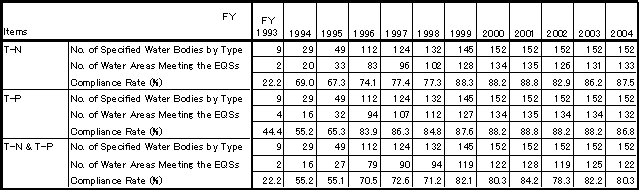
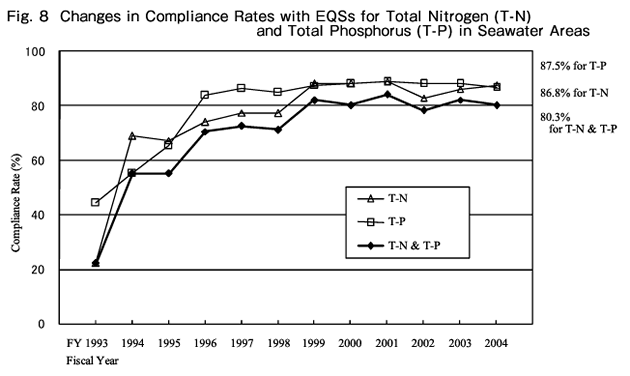
Table 11-2 Changes in Compliance Rates with EQSs for Total Nitrogen (T-N) and Total Phosphorus (T-P) in Seawater Areas
 |
| Note: |
1) |
Water areas that satisfy the EQSs for both total nitrogen and total phosphorus were defined as “a water area meeting the EQS”. |
| |
2) |
For seawater areas, there is no water area to which neither EQSs for total nitrogen nor for total phosphorus are to be independently applied. |
| |
3) |
Water quality surveys for total nitrogen and total phosphorus in seawater areas have been carried out since 1993. |
|
|








