
Indonesia
Last Updated : 28 March 2025.
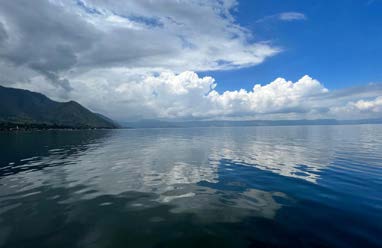
Indonesia is the world’s largest archipelagic state, with 17,504 islands, and its freshwater availability varies by region. The country has 3,137 watersheds in the National Strategic River Region and 304 in the Cross-Country River Region. While Indonesia has abundant water resources, their distribution across provinces is uneven, and rainfall amounts also differ.
State of water environment
Indonesia’s water environment has been significantly impacted by human activities, particularly in urban areas where industrial and residential waste has led to pollution. While river water quality was severely degraded from 2017 to 2020, some improvements were observed in 2021 and 2022, partly due to reduced economic activity during the COVID-19 pandemic. However, contamination remains a concern, especially in major rivers like the Ciliwung in Jakarta, which recorded extremely high fecal coliform levels. To address these issues, the government has designated key river basins and lakes for restoration, including the Citarum River and Lake Toba, as part of its national environmental strategy.
Coastal waters, vital to Indonesia’s economy and biodiversity, generally maintain better water quality than inland sources. The seawater quality index has shown improvement in recent years, with several provinces achieving good ratings. However, ongoing conservation efforts are crucial to sustaining water resources and ensuring long-term environmental and economic stability.
Please read: Outlook 2024 Indonesia
Legal framework
- Law concerning Environmental Protection and Management (Law No.32/2009) (Outside source: FAO)
- Law on Water Resources (Law No.17/2019) (Outside source: FAO, in Bahasa Indonesian)
- Government Regulation No. 22/2021 on Implementation of Environmental Protection and Management
- Environmental Approval: Regulates the licensing mechanism related to environmental matters to ensure that any activities
with potential environmental impacts have proper approval and assessment. - Water Quality: Sets standards for water quality that must be maintained, along with recovery measures in case of pollution.
- Air Quality: Defines the standards for air quality that should be preserved to protect human health and the environment.
- Sea Quality: Regulates quality standards for sea conditions to prevent marine pollution and protect aquatic ecosystems.
- Environmental Damage Control: Focuses on preventive and corrective measures to mitigate environmental degradation.
- Management of Hazardous and Non-Hazardous Waste (B3 and Non-B3): Details the handling, processing, and disposal
standards for hazardous and non-hazardous waste. - Guarantee Funds: Establishes financial assurance mechanisms for environmental recovery efforts.
- Environmental Information Systems: Implements systems for the collection and dissemination of environmental data and information.
- Supervision and Sanctions: Outlines procedures for monitoring compliance and penalties for violations related to environmental protection and management.
- Environmental Approval: Regulates the licensing mechanism related to environmental matters to ensure that any activities
Institutional arrangement

Water quality standards
Indonesia’s water quality standards are established under Government Regulation No. 22 (2021), setting minimum national criteria. Local governments may impose stricter standards or add additional parameters as needed to reflect local conditions.
-
Scope of Application
-
Inland surface water (standards approved in 2001): Includes rivers and lakes.
-
Coastal waters (standards approved in 2004): Applies to marine and coastal water bodies.
-
Groundwater: Instead of a fixed standard, water quality is regulated based on its intended use, such as for drinking, hygiene and sanitation, swimming pools, spas, bathing, and recreation (Regulation of the Minister of Health of the Republic of Indonesia No. 2 of 2023).
-
-
Groundwater Use
-
Groundwater that meets the designated criteria can be used without treatment.
-
Water use is classified into four categories based on its purpose.
-
-
River Water Quality Assessment
-
Since rivers have not been fully classified into quality classes, the Class 2 standard values are generally used for water quality evaluation.
-
-
Strengthening of Standards
-
To support water environment restoration, the national minister and provincial governors have the authority to set stricter standards (Government Regulation No. 22 of 2021, Article 115).
-
Technical standards and related information
Water management practices
Implementation of TMDL approach to industrial wastewater management
in Indonesia (WEPA international workshop 2023)