
Sri Lanka
Last Updated : 09 April 2025.

Sri Lanka is a tropical island country with an average annual rainfall of 900-5,000 mm, which provides 131,230 million m³ of freshwater annually. Zones in its southwest are the wettest, receiving over 2,000 mm/year, while northern (and some southeast) areas are considered dry zones with under 1,500 mm/year.
State of water environment
There are 103 river basins; the largest river is the Mahaweli River, covering an area of 10,448 km2 over its 335 km length (MENR and UNEP 2009). Rivers in the wet zones contribute over 50% of the runoff, despite covering only about one third of the land area. There are over 3,400 wetlands, which include ancient irrigation reservoirs, recently constructed multipurpose reservoirs, tanks and lakes.
Groundwater resources in the country are estimated at 7,253 million m3 and represent the main source of water, especially in rural areas, where around 72% of the rural population relies on them for domestic uses.
Please read: Outlook 2024 Sri Lanka
Legal framework
Laws and regulations related to water environmental management (Source: WEPA Outlook 2024):
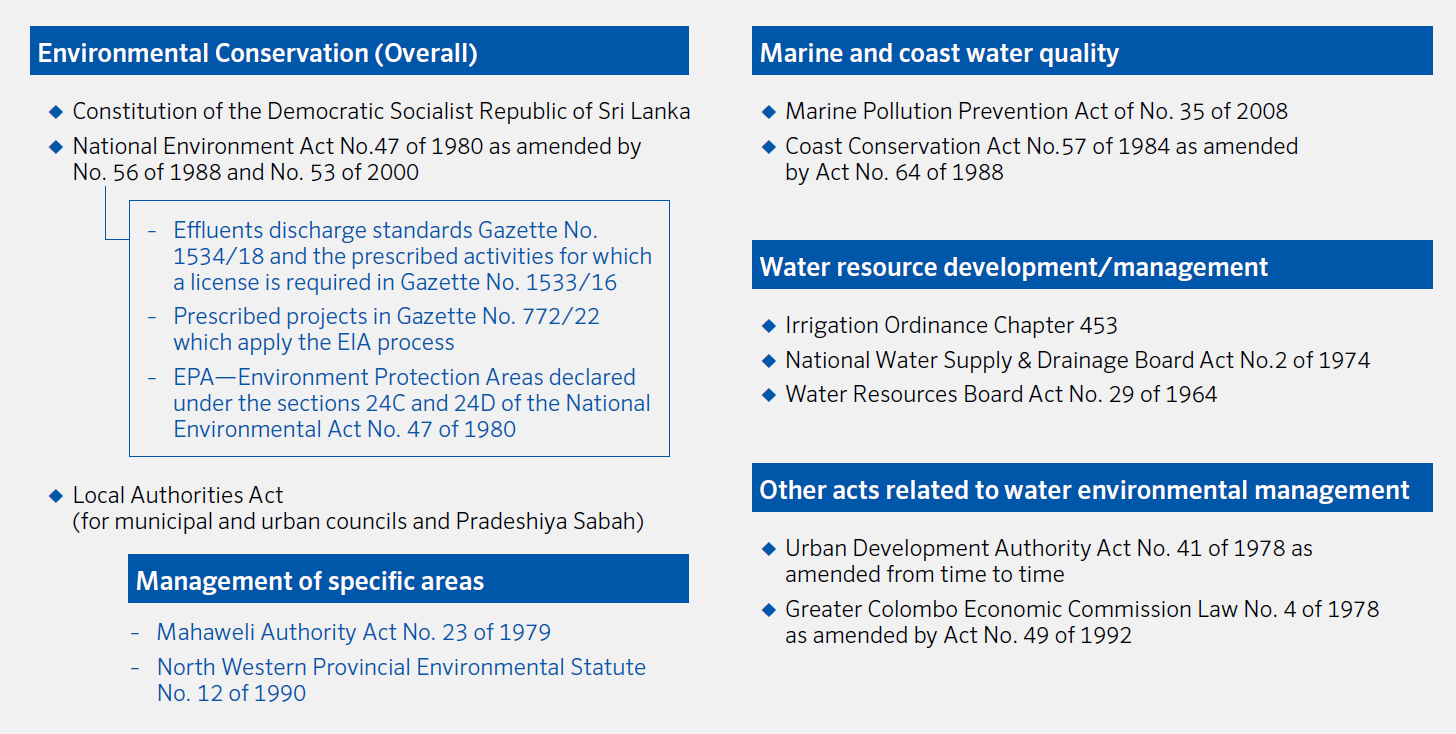
- National Environmental Act No.47 (Outside source: CEA)
- Marine Pollution Prevention Act of No. 35 (Outside source: FAO)
Institutional arrangement
| Name of the agency | Mandates of the agency |
| Ministry of Environment (MOE) | Overall management of the environment and natural resources of the country. Formulating key policies, strategies, and guidelines for environmental management. |
| Central Environmental Authority (CEA) | Overall responsibility for protecting the environment, including water environment. |
| Water Resource Board | Scientific characterization, mapping and preparation of comprehensive and integrated plans for the conservation, utilization, control and development of groundwater resources. |
| National Water Supply & Drainage | Operational development and installation of public and private water supply schemes based on groundwater and coordinated sewerage systems. |
| Department of Irrigation | Regulation and control of inland waters. |
| Mahaweli Authority | Maintenance and management of Mahaweli River and its reservoirs for development of lands for agriculture. |
| Coast Conservation & Coastal Resources Management Department | Conservation of the coastal zone and management of its resources. |
| Marine Environment Protection Authority | Protection of the marine environment from ship and maritime-related activities. |